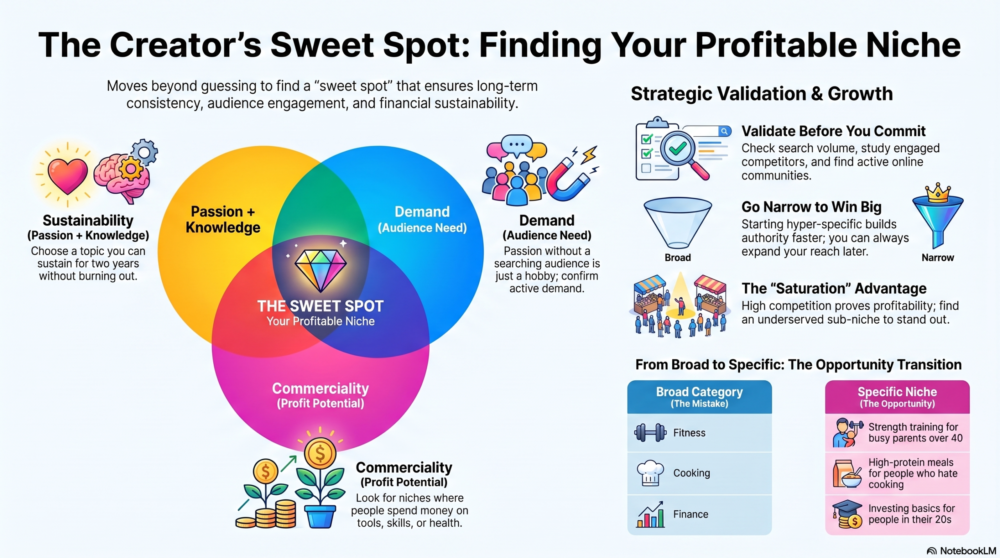
Choosing a profitable niche comes down to finding the overlap between three things: what you can create about consistently, what a specific audience actively wants, and what someone is willing to spend money on. The best niche is specific enough that you could become the go-to person for it, broad enough to never run out of content, and commercial enough that there’s a way to make money. This guide gives you a framework to find that overlap instead of guessing.
Why your niche is the highest-leverage decision you’ll make
Almost every other creator problem traces back to a vague niche. Low engagement, no clear content ideas, weak monetization, struggling to stand out — usually a niche that’s too broad. Your niche determines who follows you, what you can sell them, how easily you’re discovered, and whether brands see you as a relevant partner. Get it right and everything downstream gets easier. Get it wrong and you’ll fight an uphill battle no amount of content volume can win.
The three-circle framework
Find the intersection of these three circles:
Circle 1 — What you can sustain (passion + knowledge)
You’ll create hundreds of pieces of content on this topic. If you don’t have genuine interest or knowledge, you’ll burn out long before it pays off. This doesn’t mean it has to be your deepest passion — but you need enough curiosity and competence to keep going through the quiet early months. Ask: what could I talk about for two years without getting bored? What do people already come to me for advice on?
Circle 2 — What an audience actively wants (demand)
Passion without demand is a hobby. You need a group of people actively seeking content, answers, or community around this topic. Signs of real demand: people search for it, existing creators have engaged audiences in it, there are active communities and forums, and people ask questions about it constantly. If you can’t find anyone looking for this content, that’s a warning.
Circle 3 — What’s commercial (money)
For a profitable niche, there has to be a way to make money — products people buy, services they pay for, affiliate offers that fit, or brands that advertise to this audience. Some niches are passionate but broke; others are boring but lucrative. Look for niches where the audience spends money to solve their problem: professional skills, health, money, specialized hobbies, tools, and equipment-heavy interests all tend to monetize well.
The sweet spot is the center — something you can sustain, that people want, and that someone pays for. Miss any circle and you’ll struggle: passion + demand but no money is a popular-but-broke account; passion + money but no demand is shouting into the void; demand + money but no passion is a niche you’ll quit.
How to validate demand before you commit
Don’t just guess — check:
- Search it. Are people Googling questions in this niche? Search volume signals active demand.
- Study existing creators. Are there creators with engaged audiences here (not just big follower counts)? Engagement proves the audience cares. No creators at all can mean no demand — or an untapped gap; investigate which.
- Find the communities. Active subreddits, Facebook groups, Discord servers, and forums mean a hungry audience already exists.
- Look at what sells. Are there products, courses, tools, or services in this space? Money changing hands proves commercial viability.
Specific vs. broad: go narrow first
The most common mistake is choosing a niche that’s too broad. “Fitness,” “travel,” “finance,” “beauty” — these are categories, not niches, and you’ll compete with everyone while resonating with no one.
Niche down until it feels almost uncomfortably specific:
- “Fitness” → “strength training for busy parents over 40”
- “Travel” → “budget solo travel in Southeast Asia”
- “Finance” → “investing basics for people in their 20s”
- “Cooking” → “high-protein meals for people who hate cooking”
A specific niche gives you a defined audience, endless content angles within a clear lane, easier discovery (you rank for specific searches), and un-substitutable positioning. You become a category of one. And here’s the reassuring part: you can always expand once you own a niche. Many huge creators started hyper-specific and broadened later. You can’t do it in reverse — you can’t stand out by starting broad.
A note on “saturated” niches
People avoid niches that look crowded. Don’t overthink this. A “saturated” niche is proof of demand and money — that’s good news. The opportunity is to serve an underserved sub-niche within it, or to bring a distinct angle, personality, or depth. “Fitness” is saturated; “kettlebell training for desk workers with back pain” is wide open. Crowded categories almost always have empty sub-niches. Find the gap inside the crowd.
Common niche-selection mistakes
- Too broad — the number one error. Get specific.
- Choosing purely on passion with no demand or money behind it.
- Choosing purely on money with no genuine interest — you’ll burn out.
- Avoiding “saturated” niches that are actually proof of a profitable market.
- Niche-hopping — changing constantly so you never build authority or an audience anywhere. Pick one and commit long enough to know.
Key takeaways
- The best niche is the overlap of what you can sustain, what people want, and what’s commercial.
- Validate demand before committing: search volume, engaged creators, active communities, and products that sell.
- Go narrow first — specific niches are easier to grow, rank, and monetize.
- “Saturated” niches prove demand; serve an underserved sub-niche or bring a unique angle.
- Pick one and commit; niche-hopping prevents you from ever building authority.
Frequently asked questions
What are the most profitable niches for creators? Niches where the audience spends money to solve a problem tend to monetize best — professional skills, health and fitness, personal finance, specialized hobbies, and equipment-heavy interests. But profitability also depends on your specific angle and audience trust, not just the category.
How do I find my niche if I have many interests? Look for the overlap between your interests, where you have knowledge or curiosity to sustain content, and where there’s audience demand and a way to make money. If several pass, pick the most specific and commercial one and commit — you can expand later.
Is it bad to choose a saturated niche? No — saturation proves there’s demand and money. The key is to serve a specific underserved sub-niche within it or bring a distinct angle, depth, or personality rather than competing head-on with generalists.
How specific should my niche be? Specific enough that you could become the go-to person for it and rank for its searches, but broad enough that you won’t run out of content. When in doubt, go narrower — you can always expand once you own a niche.
Can I change my niche later? Yes. Many successful creators started hyper-specific and broadened over time as they built authority. What you want to avoid is constant niche-hopping before you’ve established yourself anywhere.
Want help pressure-testing your niche? The InfluenceClick podcast digs into positioning and finding your lane — listen to [relevant episode].